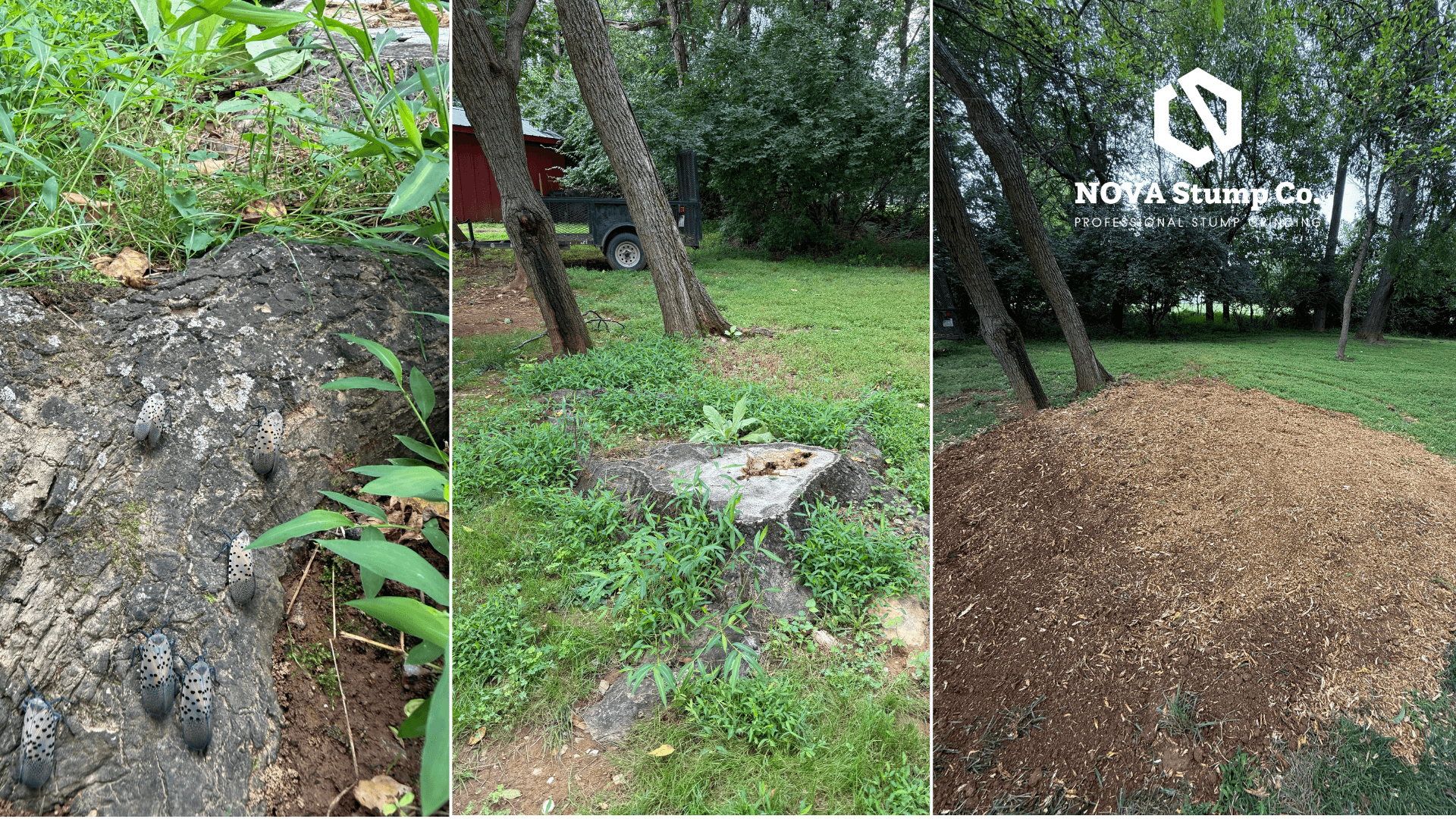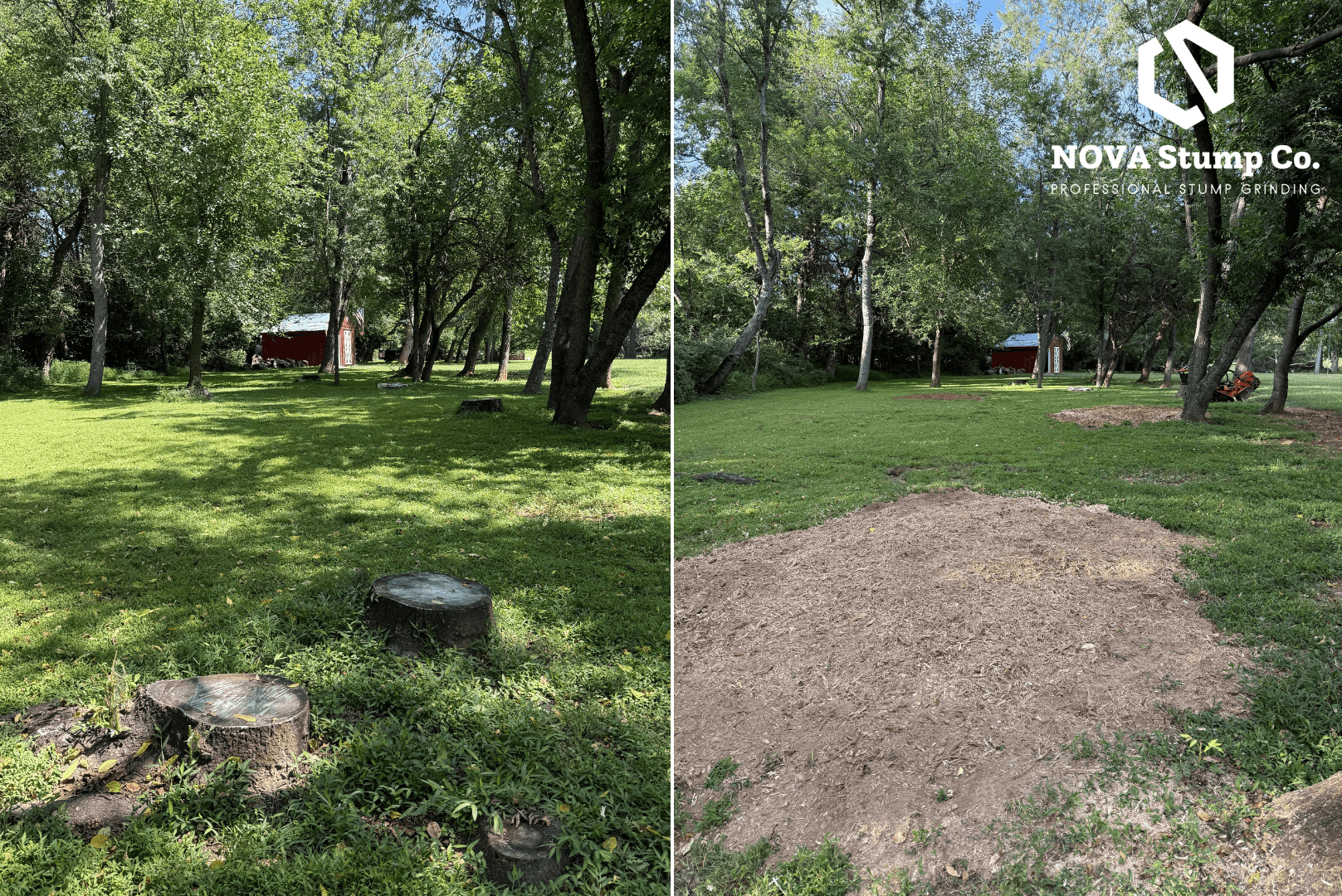
Removing a tree often leaves one final problem behind: the stump.
A leftover stump can make mowing more difficult, take up usable yard space, create a tripping hazard, or leave an otherwise clean landscape looking unfinished. Homeowners have several options, including leaving it to decay, digging it out, renting equipment, or hiring a professional to grind it below the surface.
For many residential properties, stump grinding is the most practical solution. It removes the visible stump without requiring the extensive excavation associated with pulling out the entire stump and root system.
Here is what Northern Virginia homeowners should know about how stump grinding works, what happens afterward, and when it may make sense for their property.
What Is Stump Grinding?
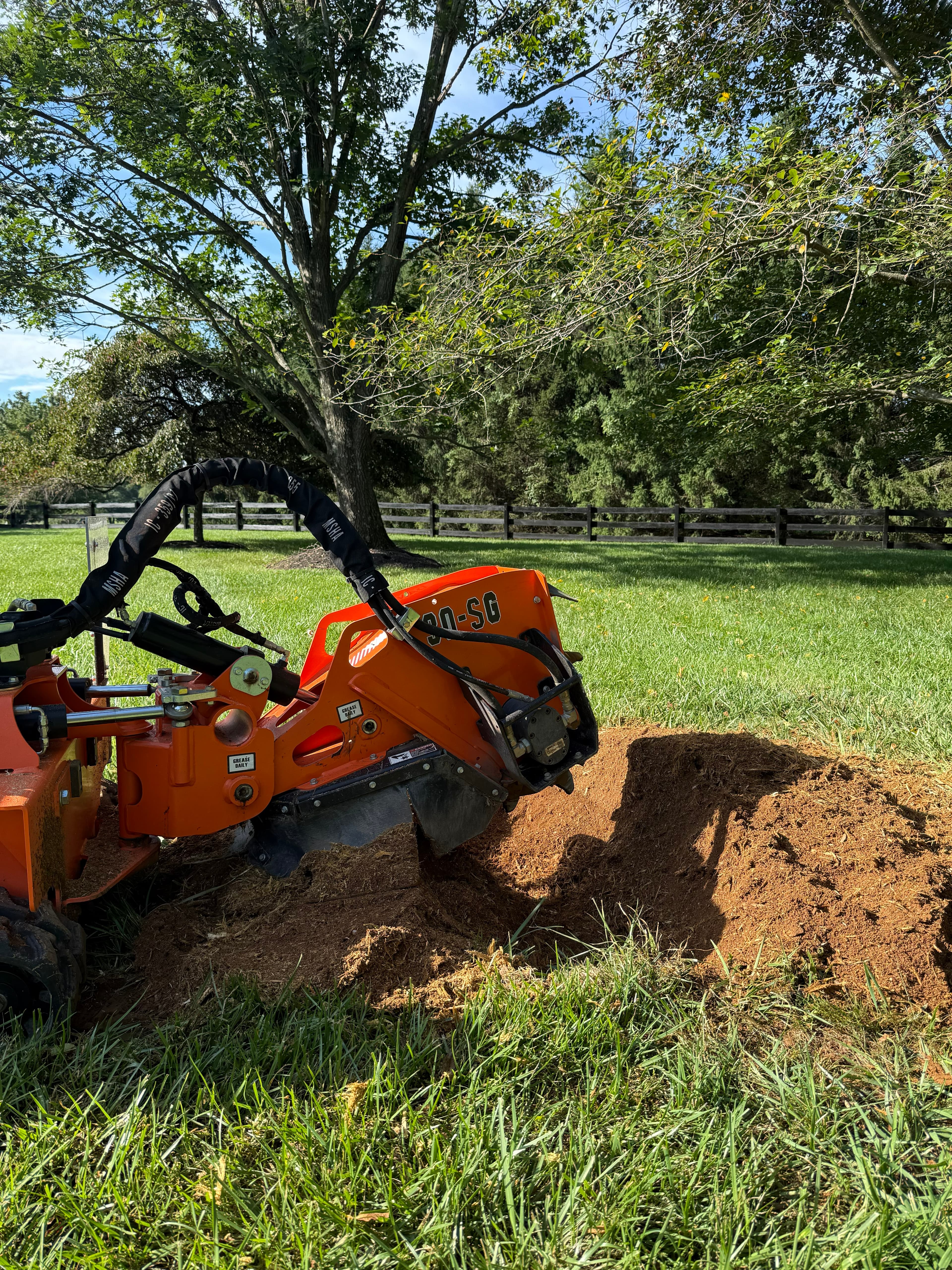
Stump grinding uses a specialized machine equipped with a rotating cutting wheel. The wheel moves across the stump in controlled passes, breaking the wood into small chips until the stump has been reduced to ground level or several inches below it.
Unlike complete stump removal, grinding does not usually extract the entire root system. Most of the roots remain underground and gradually decompose over time.
Because it avoids digging out a large root ball, stump grinding generally causes less disruption to the surrounding lawn and landscaping. It is also typically faster and less labor-intensive than complete stump removal.
Why Do Homeowners Grind Tree Stumps?
Not every stump needs to be removed. A stump in a wooded or unused area may not cause any problems. In a maintained residential yard, however, grinding can provide several practical benefits.
Reclaim usable yard space
A stump can prevent you from planting grass, expanding a garden, installing landscaping, or simply enjoying an open area of the yard. Grinding it below the surface makes the space easier to reuse.
Make mowing easier
Mowing around a stump can be inconvenient, especially when exposed roots extend into the surrounding lawn. A low stump can also damage a mower if it is accidentally struck.
Reduce tripping hazards
Stumps and surface roots may be difficult to see when covered by grass, leaves, or ground cover. Removing the visible obstacle can make the area safer for children, guests, and pets.
Improve the appearance of the yard
Even after the tree is gone, a prominent stump can make the removal feel incomplete. Grinding creates a cleaner appearance and gives homeowners more flexibility when planning future landscaping.
Remove decaying wood from the surface
Old stumps naturally begin to decay and may provide habitat for insects, fungi, and other organisms. Grinding removes most of the exposed wood, although the underground roots will continue decomposing naturally.
Stump Grinding vs. Complete Stump Removal
Although the terms are sometimes used interchangeably, stump grinding and stump removal are different processes.
Stump grinding | Complete stump removal |
|---|---|
Reduces the stump below ground level | Excavates the stump and root ball |
Leaves most roots underground | Removes a larger portion of the roots |
Causes less disruption to the yard | Creates a larger area that must be restored |
Usually faster and less invasive | Requires more labor and equipment |
Often suitable for restoring a lawn | May be necessary for construction |
For homeowners who want to eliminate a visible stump and restore the yard, grinding is often enough.
Complete removal may be more appropriate when the area will be excavated for a foundation, patio, retaining wall, addition, or another project that cannot accommodate the remaining root system.
What Happens During the Stump-Grinding Process?
The details vary depending on the property, but most residential stump-grinding jobs follow the same general process.
1. The stump and surrounding area are evaluated
Before grinding begins, the operator considers the stump’s size, height, location, and accessibility.
Nearby fences, patios, retaining walls, irrigation systems, landscape edging, rocks, slopes, and visible roots can all affect how the job is approached.
Access is particularly important. The equipment must be able to reach the stump through gates, side yards, or other parts of the property.
2. The work area is prepared
Loose rocks, metal, wire, and movable obstacles should be cleared from around the stump. Hard materials can damage the grinder’s cutting teeth or become dangerous projectiles.
Utility and private-line considerations must also be addressed before the soil is disturbed.
3. The stump is ground down
The machine’s cutting wheel is moved back and forth across the stump. Rather than removing the entire stump at once, the operator gradually grinds away small sections of wood.
The process continues until the stump reaches the agreed depth.
4. The chips are managed
Grinding produces a mixture of wood chips, soil, and small root fragments.
Depending on the scope of the service, the material may be left in a pile, raked into the depression, spread elsewhere on the property, or removed. Homeowners should confirm what cleanup is included before approving an estimate.
How Deep Should a Stump Be Ground?
The appropriate grinding depth depends on what you intend to do with the area afterward.
If the goal is simply to eliminate the visible obstruction, grinding slightly below ground level may be sufficient.
If you plan to establish grass, the stump should be ground deeply enough to leave room for a useful layer of topsoil. Reducing the stump only to the level of the lawn may not provide enough soil depth for healthy grass growth.
More extensive landscaping or construction may require deeper grinding or complete excavation. Stump grinding alone may not provide the stable base needed for a patio, shed, wall, or foundation.
This is why it helps to tell the contractor your plans for the space before work begins.
What Happens to the Roots?
Most roots remain underground after stump grinding.
Without the tree’s leaves producing energy, the roots gradually weaken and decay. How long this takes depends on the size of the root system, the tree species, soil conditions, and moisture levels.
Some species can produce shoots from the remaining roots or stump tissue. If this occurs, the shoots can often be removed as they appear. Persistent regrowth may require additional treatment or guidance from an arborist.
Grinding should therefore be understood as a way to remove the visible stump—not as a guarantee that every underground root is immediately eliminated.
Can Grass Grow Over a Ground Stump?
Yes, but the area must be prepared properly.
A common approach is to:
Remove most of the loose wood chips near the surface.
Fill the depression with suitable topsoil.
Lightly compact the soil.
Add grass seed or sod.
Water the area according to the needs of the grass.
A thick layer of fresh wood chips is not an ideal base for grass. The area may also settle as loose material compacts and the remaining roots decay, so additional soil may be needed later.
What Can You Do With the Wood Chips?
Stump grinding often creates more chips than homeowners expect.
The material can sometimes be reused around the property as mulch, particularly in naturalized areas, garden paths, or around established landscaping. Keep in mind that stump grindings are usually mixed with soil and may not look as uniform as commercial mulch.
Other options include adding a limited amount to a compost or brush pile, spreading it in a wooded area, or having it hauled away.
Avoid piling fresh chips directly against tree trunks, plant stems, or the foundation of the house.
What Affects the Cost of Stump Grinding?
Pricing varies because every stump and property is different.
The main factors include:
Stump size: Wider stumps contain more wood and require more grinding.
Number of stumps: Multiple stumps require additional work, although completing them during one visit may be more efficient than scheduling separate appointments.
Access: Narrow gates, steep grades, steps, fences, and soft ground may restrict the equipment that can reach the site.
Stump height: A tall stump contains more material and may need to be cut lower before grinding.
Surface roots: Large roots extending into the yard may increase the total grinding area.
Desired depth: Grinding deeper takes more time and creates more debris.
Rocks and buried materials: Gravel, concrete, metal, and old fencing can complicate the work and potentially damage equipment.
Cleanup: Chip removal, topsoil, and lawn restoration may be separate services rather than part of basic stump grinding.
Photos and measurements are often enough for a preliminary estimate, but unusual sites may require an in-person inspection.
Is Stump Grinding Safe?
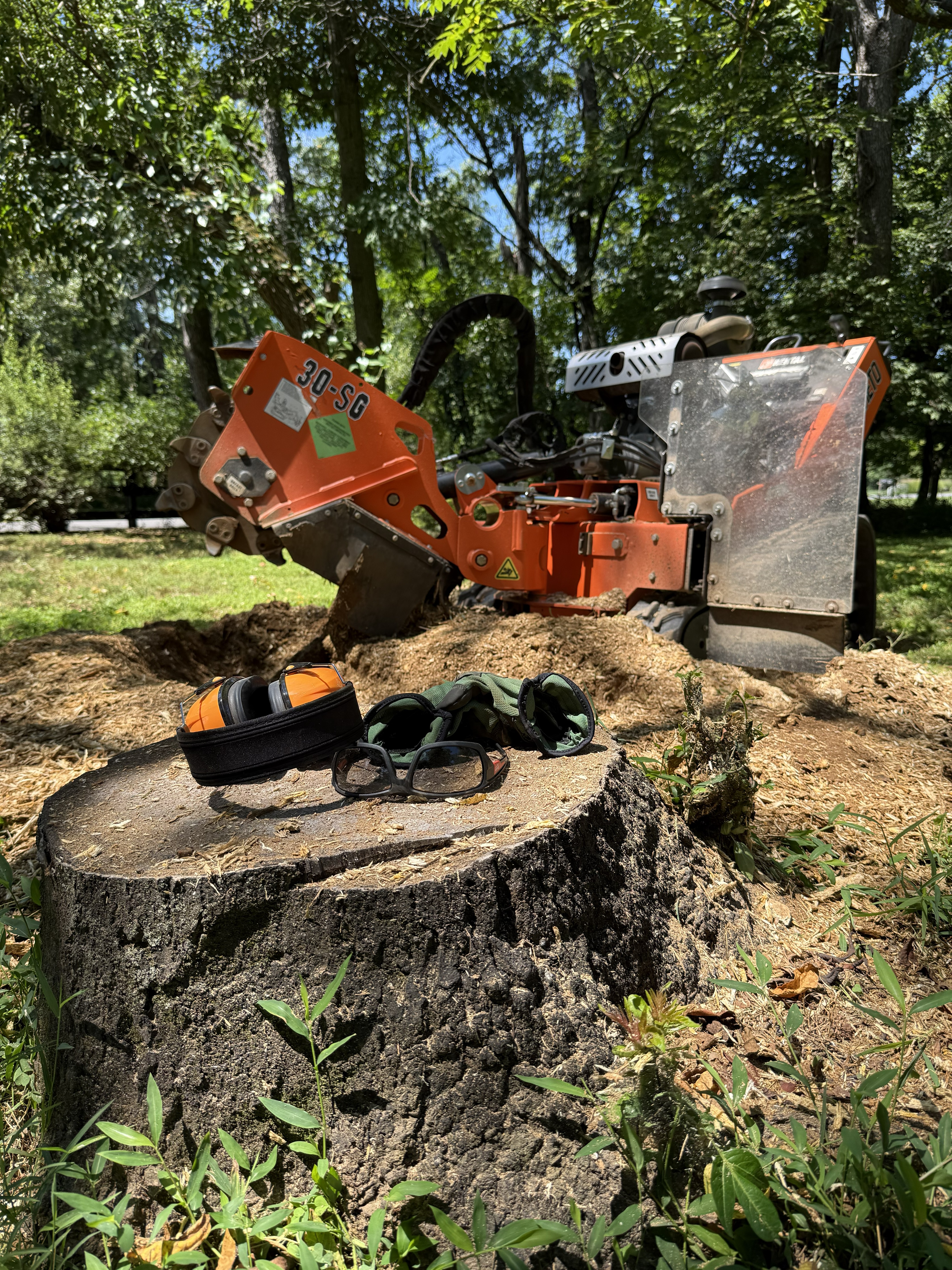
Stump grinders are powerful machines that can throw chips, stones, and hidden debris at high speed. Operators need appropriate protective equipment, training, and sufficient room to maneuver safely.
Homeowners, children, and pets should stay away from the active work area.
Underground utilities are also an important consideration. Virginia 811 should be contacted before excavation or ground-disturbing work. Public utility markings may not identify private systems such as irrigation, landscape lighting, invisible pet fencing, septic components, or private electrical lines, so homeowners should disclose any known systems.
Anyone who is uncomfortable transporting and operating heavy equipment should consider hiring a professional rather than renting a grinder.
Frequently Asked Questions
Does stump grinding remove the entire root system?
No. It removes the visible stump and reduces it below the surface, while most roots remain underground and decay naturally.
How long does stump grinding take?
A small, accessible stump may be completed relatively quickly. Large hardwood stumps, multiple stumps, difficult access, extensive roots, or deeper grinding will require more time.
Can you grind a stump near a fence or patio?
Often, yes. However, the machine must have enough room to operate safely, and access to the wood may be limited by nearby structures.
Will the ground sink afterward?
Some settling is possible as loose material compacts and roots decompose. The area may need additional topsoil later.
Can another tree be planted in the same spot?
It may be possible, but it is often better to plant nearby. Remaining roots, wood debris, and future settling can make the exact location difficult for a new tree.
When is the best time to grind a stump?
Stumps can generally be ground throughout much of the year when the property is accessible and ground conditions allow equipment to operate safely.
Professional Stump Grinding in Northern Virginia
The right approach depends on the stump’s size, location, access, and what you plan to do with the area afterward.
NOVA Stump Co. provides residential stump grinding in Arlington, Alexandria, Falls Church, Fairfax, McLean, Vienna, Springfield, Burke, Reston, Herndon, and surrounding Northern Virginia communities.
Send a few photos of the stump to request a free estimate and determine whether professional stump grinding is the right solution for your property.